Ad copy examples that earn their impression
Ad copy examples broken down by the mechanism that makes them work, with the formulas behind them and a worked rewrite of a weak line.
Updated 31 August 202612 min read
What a headline has to do in one second
A headline has one job: make the next second worth spending. Not sell, not explain, not charm. Buy the second second.
That framing kills most of the copy people write. "Premium Quality Coffee Delivered To Your Door" buys nothing, because a reader who has already scrolled past four hundred ads this morning has a filter tuned to exactly that shape of sentence and drops it before it registers. The line is grammatical, on-brand, factually true and functionally invisible.
The examples below are grouped by the mechanism that makes each one work, not by industry or platform. Industry is the least transferable thing about a good line, and platform decides only how much room you get. A mechanism transfers. If you understand why "Check the roast date on your bag" behaves differently from "Premium quality coffee", you can build that line for insurance, for accounting software, for a physiotherapist with three treatment rooms.
Every example here was written for this page. None is attributed to a real advertiser and none carries a performance figure, because the numbers quoted under screenshots on competing pages are almost never verifiable. Where an example contains a number — a price, a weight, a delivery window — treat it as a placeholder for one you can actually substantiate. A specific claim you cannot defend is worse than a vague one.
Six mechanisms that make a line work
Specificity
Replace the adjective with the measurement.
Resoles for £38. Most cobblers quote £70 and keep the shoe three weeks.
Two hundred grams. Folds down to the size of a paperback.
Ships in a box that fits through a letterbox.
A number is evidence of having done the thing. Anyone can write "lightweight". Only someone who has put the product on a scale writes "two hundred grams", and the reader knows that below the level of conscious reasoning. The adjective asks to be believed. The measurement asks to be checked, and the invitation to check is what buys the second.
The cost is real. A specific line commits you: "Roasted Tuesday, delivered Thursday" is an operational promise, and if fulfilment slips to Friday the ad becomes a complaint generator. Copy that binds operations is a feature rather than a bug, but somebody in the room should agree to it before it runs.
The named objection
Say the thing the reader is already thinking, before they finish thinking it.
Yes, it's another notes app. This one opens in under a second.
It costs more than the supermarket version. Here's the part they leave out.
Two hours to assemble. We tested it on people who had never held an Allen key.
Naming the objection defuses it and buys credibility in the same clause. The reader's counter-argument runs whether you address it or not, and while it runs they are not reading you. Pre-empting it also signals that you have talked to customers, which is rarer than it should be and which the reader can sense.
This fails when the objection you name is not the one they hold. Write "you might think it's expensive" to an audience whose real hesitation is that they doubt the thing works, and you have handed them a price objection they had not yet formed. Get the objection from support tickets and sales calls, never from a brainstorm.
The reframe
Change what the purchase is a purchase of.
You're not buying the knife. You're buying never sharpening one again.
The dishwasher is the cheap part. The forty minutes an evening is the expensive part.
A second monitor costs less than the hour a week you spend switching windows.
A reframe moves the price comparison onto a different axis. Once the reader accepts that the product is a purchase of time rather than of hardware, the £200 sticker stops being weighed against other knives and starts being weighed against an hour of their own evening. It is the hardest of the six to execute without sounding pleased with yourself.
The failure mode is an axis the reader rejects. If they genuinely do not care about the dimension you moved to, the line reads as an evasion of the price question rather than an answer to it.
The load-bearing number
One figure, carrying the whole argument, with nothing beside it to compete.
Eleven parts. Four screws. One tool, included.
£4.20 a week.
Three hundred washes before the seal needs replacing.
This is not the same as specificity. Specificity substitutes evidence for adjectives anywhere in a line. This strips the sentence back until a single figure is the only thing left standing. "£4.20 a week" reframes a £218 annual price without using the word annual, in nine characters.
One number per headline. Two, and the reader arbitrates between them instead of absorbing either. Put the second figure in body text where it can be a supporting fact rather than a rival claim.
The second-person imperative
Give an instruction the reader can carry out inside their own life, in the next thirty seconds, that produces evidence in your favour.
Check the roast date on your bag.
Measure your doorway before you order anything else.
Cancel the second subscription first. Then talk to us.
The imperative works because it is not asking for the sale. Whoever walks to the kitchen and looks at the date on the bag has just been sold to by their own cupboard, and there is no more trusted salesperson than that.
It only works when the check genuinely favours you. If a meaningful share of readers look and find nothing wrong, the mechanism inverts and you have done your competitor's job at your own expense.
The withheld detail
Name that something exists without naming what it is.
We changed one thing about the hinge. It's the reason there's a waiting list.
The fourth ingredient is the one you'll notice.
There's a reason we won't ship it to Arizona in July.
This is the most abused mechanism on the list, because it is the easiest to fake. What separates the working version from clickbait is whether the landing page pays the detail off above the fold, in plain language, within about two seconds of arrival. If the reader has to hunt for the hinge, you have spent your credibility and bought a bounce.
Use it rarely, and never for a detail that turns out to be dull. "The fourth ingredient" had better be interesting.
Where your line gets cut
The most common practical failure in ad copy is not a weak mechanism. It is a good line that arrives at the auction a few characters too long and truncates mid-clause, or a headline written to Instagram's allowance and served on Facebook Feed, where Meta recommends less than three-quarters of it. Almost no example gallery mentions this.
Two distinctions decide the table below. First, a recommended length is not a hard cap: LinkedIn accepts a 3,000-character introduction and then hides nearly all of it behind "see more". Second, Meta's Ads Guide does not give Facebook Feed and Instagram Feed the same numbers, which contradicts the single combined figure repeated across most Meta copy roundups.
| Platform and field | Recommended | Hard cap | Notes |
|---|---|---|---|
| Facebook Feed, primary text | 50–150 | — | Meta's Ads Guide gives Feed a range, not a flat 125 |
| Facebook Feed, headline | 27 | — | Feed-specific, and noticeably tighter than Instagram |
| Instagram Feed, primary text | 125 | — | Meta's Ads Guide |
| Instagram Feed, headline | 40 | — | Meta's Ads Guide |
| Instagram Feed, hashtags | — | 30 | Counted against the caption |
| Google responsive search ad, headline | — | 30 | Three required, up to 15 |
| Google responsive search ad, description | — | 90 | Two required, up to four |
| Google responsive search ad, display path | — | 15 each | Two path fields |
| Google Demand Gen, headline | — | 40 | |
| Google Demand Gen, description | — | 90 | |
| Google responsive display, business name | — | 25 | |
| LinkedIn single image, introductory text | 150 | 3,000 | 150 is LinkedIn's stated truncation threshold |
| LinkedIn single image, headline | 70 | 200 | |
| LinkedIn single image, description | 100 | 300 | |
| TikTok auction in-feed, display name | — | 20 | 10 for Chinese, Japanese and Korean |
In double-width languages, Google counts every character as two, which halves the working space rather than the word count. TikTok's auction in-feed help page describes caption truncation in displayed lines rather than characters — a maximum of four lines, with the remainder behind "see more" — so write for the first line and treat everything after it as optional.
The consequence worth acting on: a 27-character Facebook Feed headline and a 30-character Google search headline are close enough that one line serves both, while a 70-character LinkedIn headline is a different piece of writing. Write the short one first. Expanding a tight line is easy. Compressing a loose one usually destroys the mechanism that made it work.
Copy for video obeys a clock, not a character count
Video copy has no character limit, which is why so much of it is bad. The constraint is time, and it is far harsher.
TikTok's own creative guidance tells advertisers to prioritise the hook in the first six seconds and to pace on-screen captions at five to ten words per second. Google's ABCD playbook is blunter still: introduce the product or brand in the first five seconds, aim for two or more shots in that window, and frame tightly on the subject. If people appear, ABCD advises opening with them on screen, addressing the audience directly.
Run the arithmetic before you write. At TikTok's caption pacing, a six-second hook holds somewhere between thirty and sixty words of on-screen text, and that is a ceiling rather than a target, because the caption is competing with the footage for the same eye. The mechanisms above still apply, but the imperative and the load-bearing number survive compression better than the reframe, which needs a clause to set up the swap and a clause to land it.
A headline is only half an ad
Most ad copy fails because it was written in a document, approved in a document, then handed to a designer who never saw the argument it was making. The line and the image end up saying the same thing twice, or worse, arguing with each other.
"Two hundred grams" over a photograph of the product on a table says nothing. The same line over a hand holding it says the whole thing at once. When the copy asserts what the image already proves, you have spent your headline on redundancy. When it asserts what the image contradicts, the reader believes the image and stops trusting you. The strongest pairing is a division of labour: the picture carries the object, the line carries the claim the object cannot make about itself.
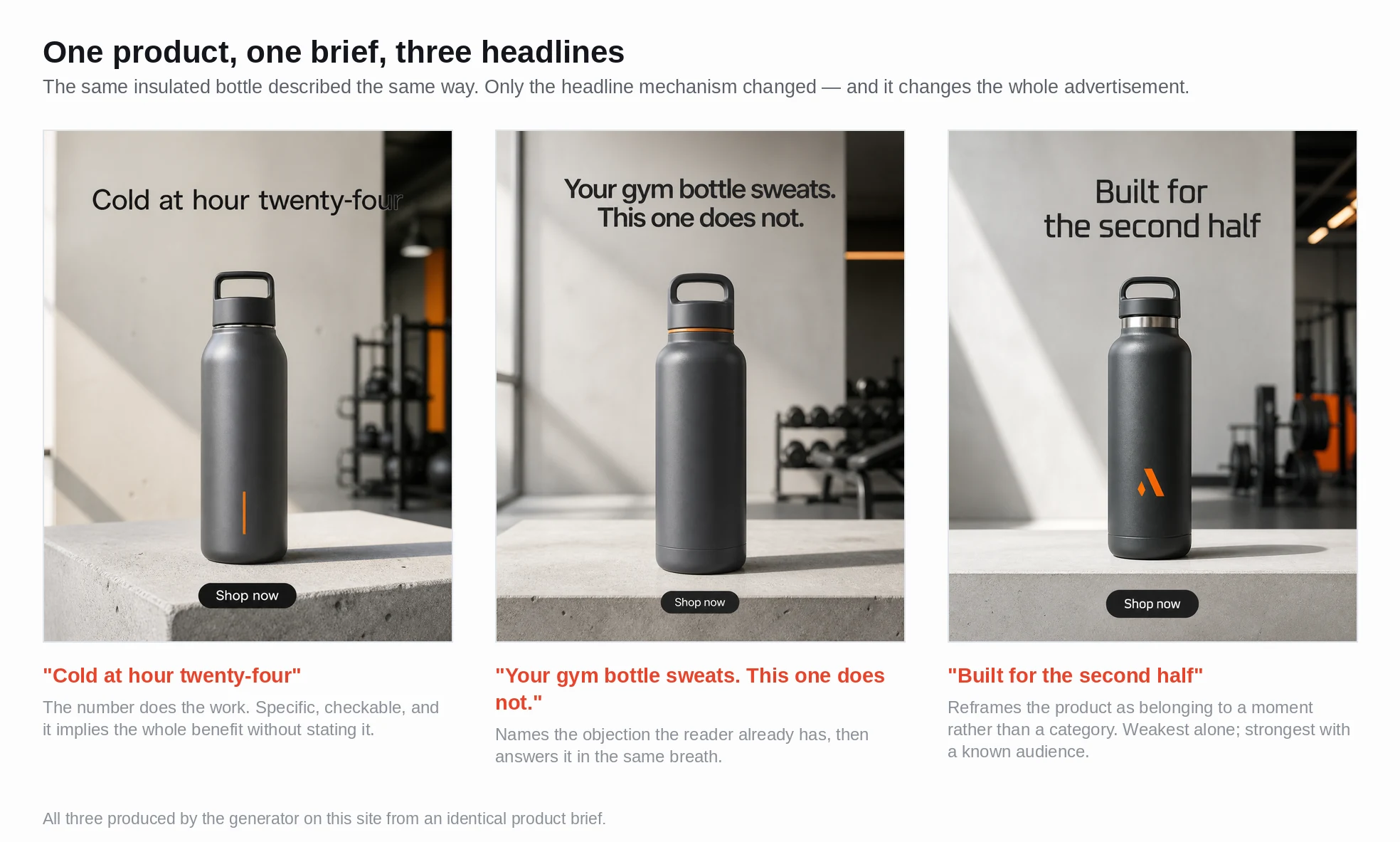 One product, one brief, three headlines: the line does not sit on top of the creative, it reorganises it.
Which is the argument for writing the line and seeing it rendered in the same sitting rather than approving it flat in a spreadsheet. Pushing three candidate headlines through an ad generator and comparing three finished creatives takes a couple of minutes and settles disputes that a copy document cannot, because a line that reads well at twelve points can be illegible at the size it will actually occupy in a feed.
The worked rewrite
Start with a genuinely weak line, of the kind that gets approved somewhere every day.
v0. Premium Quality Coffee Delivered To Your Door
It fails on all six mechanisms. "Premium" and "quality" are adjectives without evidence, delivery to your door is true of nearly everything sold online, and there is no number, no objection and no instruction.
v1. Roasted Tuesday. At Your Door Thursday.
Specificity, applied bluntly. Two checkable facts replace two adjectives, and the gap between them implies freshness without claiming it. The cost: an operational commitment, and the line still assumes the reader already cares about roast dates. At 39 characters it just clears Instagram Feed's recommended 40 and badly overshoots Facebook Feed's 27.
v2. Supermarket Coffee Is Four Months Old
Named objection, and much sharper, because it explains why roast dates matter instead of assuming it. The cost: this is now a competitor claim you must defend if challenged, and it says nothing about you. Someone could read it, agree entirely, and buy a different bag.
v3. Check the roast date on your bag.
Second-person imperative. Same argument as v2, but the reader proves it themselves, in their kitchen, with their own coffee, and you have claimed nothing that needs defending. At 33 characters including the full stop it fits Instagram and Facebook Feed comfortably; trimmed to "Check your bag's roast date" it lands on exactly 27, which clears Facebook Feed's recommendation and Google's 30-character search headline cap in one move.
That is the one I would run, with v1 underneath as the body line, because the imperative earns the attention and the specificity closes it. With three lines in that shape, the useful next step is to generate an ad for each and judge them at full size instead of arguing about them in a document.
When nothing lands
Formulas — problem-agitate-solve, before-after-bridge, and the rest of the acronyms in circulation — are scaffolding. They tell you what order the parts go in. They do not supply the parts. Applied to a weak offer, a formula produces a well-structured weak ad, and the structure makes the weakness harder to see, which is the genuinely dangerous outcome.
So when six mechanisms and four rewrites still produce nothing that reads well, the problem has moved upstream. Either the offer has no specific advantage you can name, or you are talking to people who do not have the problem. Neither is fixable in a headline. Go and find the sentence a real customer used when they explained why they bought, and start from that. It will be uglier than anything you would write, and it will work better.